Reset Limiting Beliefs: 30-Day Plan to Build Confidence
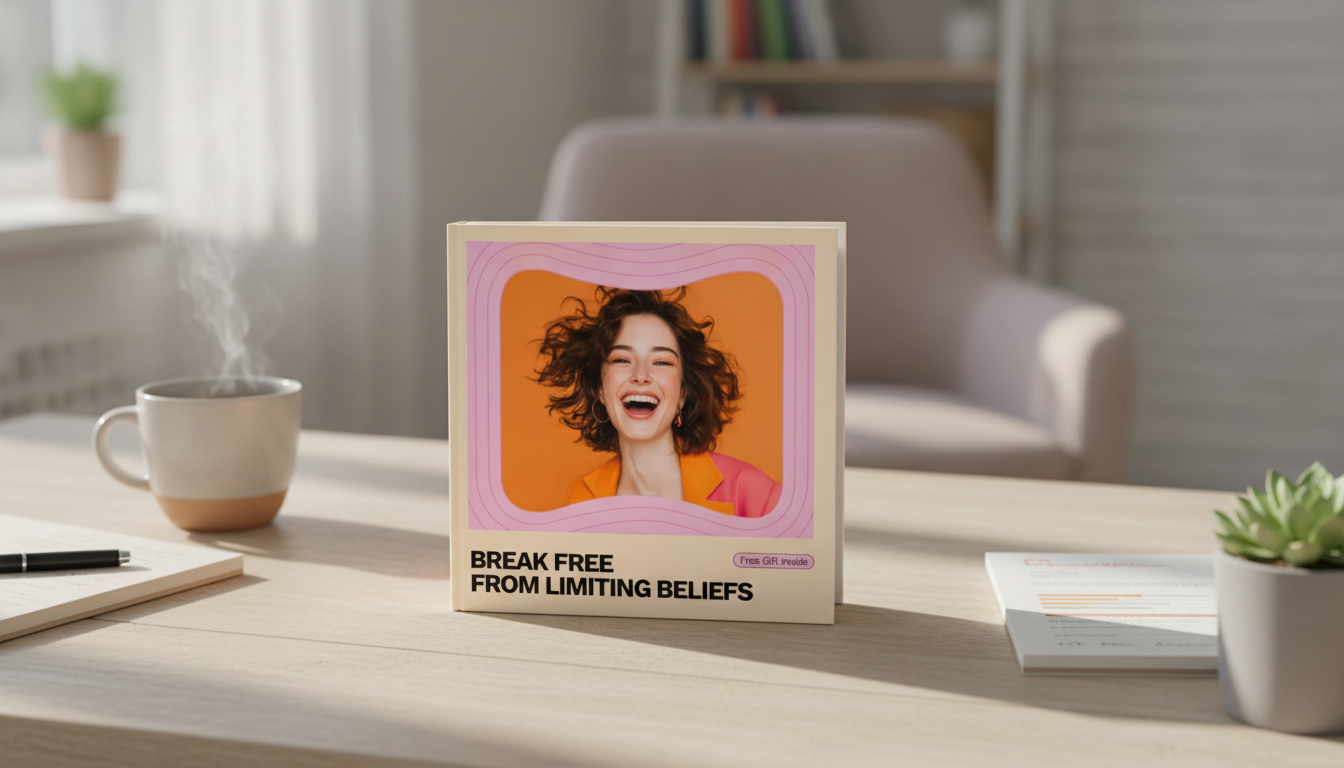
Break Free from Limiting Beliefs: A Practical Mindset Reset for Confidence and Personal Breakthrough
Limiting beliefs often sound like “I’m not good enough,” “I always mess this up,” or “People like me don’t succeed.” They can feel like facts, but they’re usually learned conclusions formed from past experiences, social messages, and repeated self-talk. Shifting them isn’t about forcing positivity—it’s about replacing untested assumptions with evidence, new behaviors, and self-trust. Below is a clear, step-by-step process to identify the beliefs holding confidence back and build a mindset that supports growth and follow-through.
What limiting beliefs look like (and how they quietly run decisions)
Most limiting beliefs fall into a few repeating categories: self-worth (“I don’t deserve”), ability (“I’m not smart/talented”), belonging (“I don’t fit in”), safety (“It’s risky to be seen”), and success (“If I win, I’ll lose people”). The tricky part is they don’t always announce themselves as fear. They often show up as “practical” choices—procrastination, perfectionism, people-pleasing, overthinking, avoiding visibility, or quitting early to avoid disappointment.
This is the loop that keeps them alive: belief → emotion (anxiety/shame) → behavior (avoidance or over-control) → result (stuck) → “proof” the belief was true. A useful test is simple: if a thought creates helplessness and shuts down action, treat it as a hypothesis—not a verdict.
Limiting belief patterns and confidence-building replacements
| Pattern | What it sounds like | Hidden fear | More accurate reframe | Micro-action to prove it |
|---|---|---|---|---|
| All-or-nothing thinking | If it’s not perfect, it’s pointless. | Being judged | Progress counts even when imperfect. | Submit a “draft version” once this week. |
| Overgeneralizing | I failed before, so I’ll fail again. | Repeating pain | One outcome doesn’t define the next attempt. | Try again with one changed variable. |
| Mind reading | They’ll think I’m incompetent. | Rejection | No one can know without evidence. | Ask for specific feedback from one person. |
| Identity labeling | I’m just not confident. | Being stuck forever | Confidence is a skill built by reps. | Do one uncomfortable task for 10 minutes. |
| Catastrophizing | If I speak up, everything will go wrong. | Loss of control | Most outcomes are manageable. | Share one idea in a low-stakes setting. |
Find the belief under the problem: a 10-minute clarity process
Start with a recurring frustration—something that keeps happening even though you “know better.” Examples: not applying for roles, not posting your work, not setting boundaries, or playing small in relationships.
-
Write the trigger moment. Use: “When X happens, I feel Y and do Z.” Keep it specific and recent (today or this week).
-
Ask the uncovering question. “What would it mean about me if I did the scary thing and it went badly?” The first honest answer is usually the core belief.
-
Name the cost. List three ways this belief limits relationships, money, health, or creativity. Cost creates clarity.
-
Choose a believable target belief. Not an extreme opposite—just something you can practice, like “I can learn,” “I can handle discomfort,” or “I can improve through practice.”
Challenge the belief without forcing positivity
Some beliefs won’t budge with pep talks because your nervous system wants proof. That’s where a grounded approach helps.
-
Evidence audit: Write proof “for” the belief and proof “against” it. Most limiting beliefs look shaky when both sides are visible. Approaches like Cognitive Behavioral Therapy (CBT) use this kind of thought-testing to reduce emotional distortion (see the American Psychological Association’s overview of CBT).
-
Alternative explanations: Identify at least two non-personal reasons a past situation went poorly: timing, unclear expectations, lack of practice, missing support, or simply not knowing what you know now.
Build confidence through small experiments (not motivation)
For a broader framework on developing an ability-focused perspective, growth mindset research emphasizes skills as trainable rather than fixed traits (see Stanford’s Mindset Works overview).
A 30-day mindset reset plan for personal breakthrough
Checkpoint questions: “What did I do that my old belief said I couldn’t?” and “What proof do I have now?” If emotions feel intense or sticky, CBT-style tools can also be used alongside professional support (the NHS CBT resource is a helpful primer).
Make it stick: environment, relationships, and self-talk that support growth
A guided resource for changing limiting beliefs day by day
A structured guide can turn insight into consistent practice by giving you prompts, exercises, and a repeatable routine. If you want a ready-to-use workbook-style format, Break Free from Limiting Beliefs – Transform Your Mindset Guide is designed to help with belief identification, reframing, and action experiments you can repeat whenever you feel stuck.
For a lighter daily spark—especially on days when momentum feels low—Shifting Seasons: Inspiring Quotes That Spark Life-Changing Moments (eBook) can pair well with the 30-day plan: one short reflection plus one micro-action that builds real-world confidence.
FAQ
Why do limiting beliefs feel true even when they aren’t?
They’re reinforced by selective attention, emotional memory, repetition, and avoidance behaviors that prevent collecting new evidence. When the belief drives the behavior and the behavior keeps you stuck, the result can feel like “proof,” even if the belief started as a guess.
How long does it take to change a limiting belief?
Most people notice shifts in weeks, but lasting change often takes a few months of repeated proof-building. Consistency, how often you run small experiments, and the amount of support you have all affect the timeline.
What if I know my limiting belief is irrational but still feel stuck?
Pair cognitive reframes with behavioral experiments and simple nervous-system regulation (slow breathing, grounding, brief movement) so your body can learn safety along with your mind. If the belief is tied to trauma or persistent anxiety/depression, professional support can make progress steadier and less overwhelming.















Leave a comment